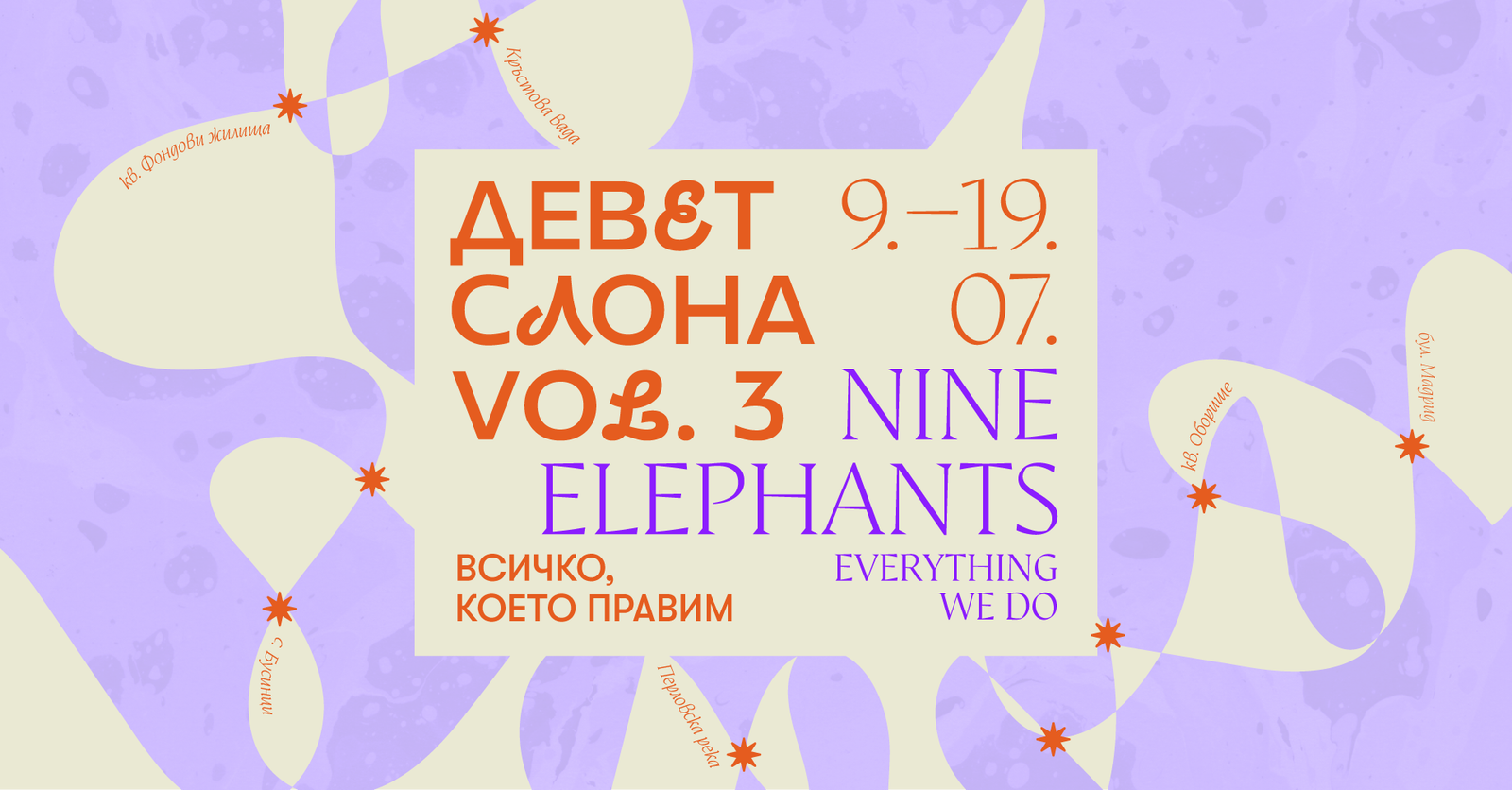
The third edition of Nine Elephants – a festival for art in the urban environment, will take place from 9 to 19 July.

The new festival edition, titled Everything We Do, connects the city with our actions – from everyday activities and micro-gestures, to the city as a place for work and learning, to the better things we could do, if only something were not holding us back.

Between habit and radical change, between economic labor and invisible care, a broad ecology of interactions unfolds — shaping the city as it is, but also as it could be.

For the third consecutive year, artists, researchers, and conductors, as well as concrete, banitsa makers, and bees—set out from the city center toward its many peripheries: neighborhoods, villages, and rivers. Their projects raise questions about the invisible labor within community cultural centers as a form of sustaining collective life; about the desire to start life anew by relocating an entire village; about the queue in front of the shop as a game, and rest as work. The finale will take us to one of the city’s working-class districts, where an entire choir will sing the memory of the urban master plan.

Among the highlights of this year’s program is once again Sofia Night Performance, while during the second week we will gather at the Botanical Garden of the Bulgarian Academy of Sciences on the Ring Road. For the second consecutive year, we will also create a space for informal exchange of practices and interventions in the urban environment.

Full program coming soon!

With the financial support of the National Culture Fund and the Ministry of Culture.

About the projects

This year artists, researchers, and conductors, as well as concrete, banitsa makers, and bees set out from the city center toward its many peripheries with the aim to understand what we actually do and how it changes Sofia. In this edition, you will encounter projects about invisible labor as a form of sustaining collective life — such as in community cultural centers (a storytelling project by Maria Getova and Elena Stoycheva); early labor — like that of the banitsa maker, a form of care that exists even while we sleep (a performance by Lora Krastva); and the everyday work at the Krasno Selo market, tracing the threads that connect its stalls without entangling them (an installation by Victoria Nikolova and Isun Kim).

We will also move back in time — toward forms of labor from the pre-industrial era of intense physical work (an interactive performance by Kexin Hao), and take a walk through Fondovi Zhilishta — one of Sofia’s historic workers’ neighborhoods — where a choir will sing the memory of the urban plan (with New Choir, Pavel Naydenov, and visual interventions by Vasilena Gankovska). Beyond time, we will also explore other perspectives — those of bees and their organizations, of plants, and of the paths of Sofia’s rivers, whose movements connect different geographies and contexts (a curated walk by Marie de Pasquier).

Sometimes everything we do truly encompasses everything — as when an entire village relocates to begin anew, as in the case of Zhelezhnitsa (a project by Maria Makedonska and Nikola Zambeli). At other times, everything we can do is simply stand in line — feeling like a “like” on social media, without knowing why we are queuing (Jana Romanova’s performance “The Queue is the Game”). Or to ask when a street actually rests (a performance by Silvia Cherneva), and what we do when a hole cannot fill itself (a project by Paola and Anna Maria).

Among the main events this year is Sofia Night Performance, “Choreographies of Labor,” which focuses on different forms of labor — often invisible, often as care — from embodied gestures to collective organizational models (with Yana Romanova, Lora Krasteva, Gergana Dimitrova, Kexin Nao, Silvia Cherneva, Maria Minkova, and others.).
In the second week, we invite you to Opera Ecologica in the Botanical Garden of the Bulgarian Academy of Sciences, where attention turns to another kind of work (from the Latin opus) — that of plants and more-than-human systems. In the interaction between living and non-living entities, a poetics of interdependence emerges, which we think of as opera — simultaneously work, process, and a celebration of invisible possibilities (with Deyana Stareva and Hione Cerato, Violeta Tsenova and Cemili Raym, Alessia Simonetti and Valentina Scharra, Maria Minkova, Mitko Mitkov and Mona Steinwieder).

Team

Curator: Victoria Draganova
Coordinator: Anna Ivanova
Assistant: Kristiyana Barzinska
Communication: Rene Georgieva
Photo documentation: Rosina Pencheva / Capturing Creativity
Visual identity: Crunchy Oyster

With the financial support of

Programme “Creation”, National Culture Fund
Cultural Calendar of Sofia Municipality – “Summer Programme”
Ministry of Culture

Partners

Oborishte District
Serdika District
KADIST
Na kino na selo
Gradoscope
Read Sofia / Literary Routes

Participants

girls canscan (Lila Kamerman), Gergana Dimitrova, Anna-Maria Ivanova & Paola Dimova, Lora Krasteva, Maria Makedonska & Nikola Zambeli, Maria Minkova, Viktoria Nikolova & Isul Kim, Lea Novak, Mitko Mitkov & Mona Steinwider, Pavel Naydenov & Franki Dobenfeld, Ina Maria Satleger, Benedikt Gerhard Kremsner [part of New Choir] & Vasilena Gankovska, Off-Centre (Justine McKenna, Ismini Kiritsis, Martina Latuka), Marie de Pasquier, Jana Romanova, Valentina Sciarra & Alessia Simonetti, Deyana Stareva & Jaione Cerrato, Elena Stoycheva & Maria Getova, Kexin Hao, Violeta Tsenova & Jemily Rime, Silvia Cherneva

Locations

Oborishte district, Madrid Blvd., Krasno Selo market, Robov Dol Park, Fondovi Zhilishta district, Vladayska River (in the area of Krastova Vada)
Botanical Garden of BAS (Ring Road)
“Nikolay Haytov – 1936” Community Center, Nadezhda district
Swimming Pool
Busintsi village, Zheleznitsa village

Main Parnters