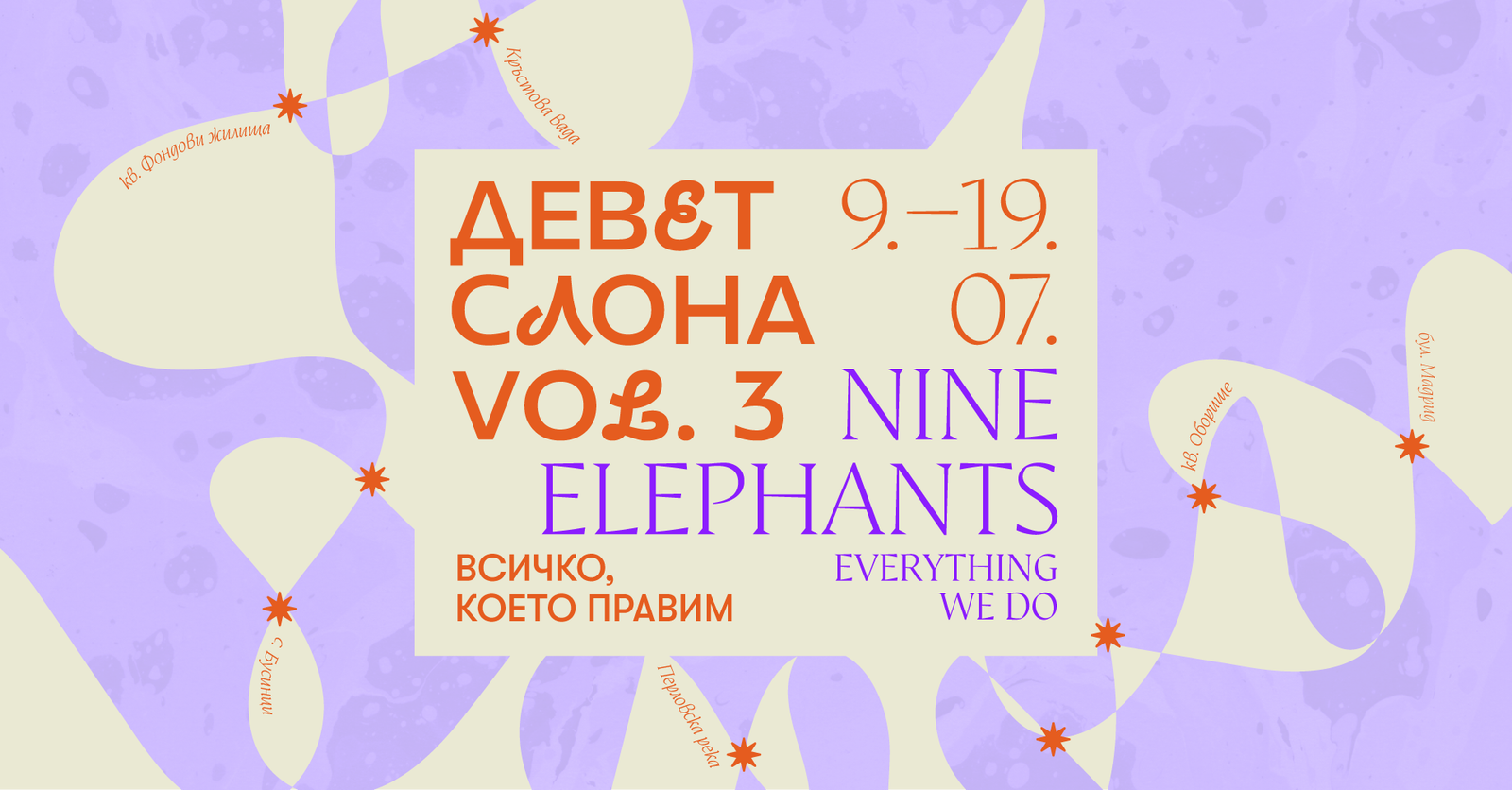
The third edition of Nine Elephants – a festival for art in the urban environment, will take place from 9 to 19 July.

The new edition of the festival, titled “Everything We Do,” connects the city to our actions—from everyday activities and micro-gestures, through the city as a place of work and learning, to the better things we could do but, for some reason, do not. Between habit and radical change, between economic labor and invisible care, unfolds a broad ecology of interactions that shape the city as it is today, while also revealing what it could become.

For the third consecutive year, artists, researchers and conductors, as well as concretes, bakers and bees set out from the city centre toward its many peripheries. Their projects raise questions about invisible labour in urban cultural centres as a form of sustaining community; about the desire to start life anew by moving one village to another place; about the queue outside the shop as a form of play, and rest as a form of work.  

This year’s edition includes more than 20 artistic projects, developed in partnership with two of the capital’s districts, as well as several cultural organizations and institutions. Once again, the festival opens its programme to international participation, with KADIST — KADIST — serving as its main international partner this year, one of the leading contemporary art organizations with an important collection of video and art films.  

The festival continues its commitment to decentralization by developing artistic projects outside the central areas of Sofia and fostering long-term interactions with local communities. In 2026, the programme reaches the neighborhoods of Fondovi Zhilihta, Iztok, Dragalevtsi, and Krasna Vada, as well as Robov Dol Park, and the villages of Businci and Zheleznitsa. Within the festival, the international peer-to-peer forum “Spontaneous Cities” — Spontaneous Cities — will also take place, creating a space for the exchange of experiences and practices in the field of urban interventions and research.  

Among the main events in this year’s programme, the festival will open with Echo Location, an exhibition by Vlatka Horvat at Swimming Pool. On the first Friday evenging, Sofia Night Performance returns under the title “Choreographies of Labour”, featuring performances, theatrical and artistic interventions, workshops, and poetry. In the second week, we invite you to Opera Ecologica at the Botanical Garden of the Bulgarian Academy of Sciences on the Ring Road. The finale will take us to the Fondovi Zhilihta neighbourhood, where the New Choir from Vienna will sing the memory of the urban planning scheme.

По повод фестивала излиза и първото издание на наръчника за изкуство в градска среда „Градове с въображение“.

On the occasion of the festival, the first edition of the handbook on art in urban environments, “Imagining Cities,” is also being published.

About the projects

This year artists, researchers, and conductors, as well as concrete, banitsa makers, and bees set out from the city center toward its many peripheries with the aim to understand what we actually do and how it changes Sofia. In this edition, you will encounter projects about invisible labor as a form of sustaining collective life — such as in community cultural centers (a storytelling project by Maria Getova and Elena Stoycheva); early labor — like that of the banitsa maker, a form of care that exists even while we sleep (a performance by Lora Krastva); and the everyday work at the Krasno Selo market, tracing the threads that connect its stalls without entangling them (an installation by Victoria Nikolova and Isun Kim).

We will also move back in time — toward forms of labor from the pre-industrial era of intense physical work (an interactive performance by Kexin Hao), and take a walk through Fondovi Zhilishta — one of Sofia’s historic workers’ neighborhoods — where a choir will sing the memory of the urban plan (with New Choir, Pavel Naydenov, and visual interventions by Vasilena Gankovska). Beyond time, we will also explore other perspectives — those of bees and their organizations, of plants, and of the paths of Sofia’s rivers, whose movements connect different geographies and contexts (a curated walk by Marie de Pasquier).

Sometimes everything we do truly encompasses everything — as when an entire village relocates to begin anew, as in the case of Zhelezhnitsa (a project by Maria Makedonska and Nikola Zambeli). At other times, everything we can do is simply stand in line — feeling like a “like” on social media, without knowing why we are queuing (Jana Romanova’s performance “The Queue is the Game”). Or to ask when a street actually rests (a performance by Silvia Cherneva), and what we do when a hole cannot fill itself (a project by Paola and Anna Maria).

Among the main events this year is Sofia Night Performance, “Choreographies of Labor,” which focuses on different forms of labor — often invisible, often as care — from embodied gestures to collective organizational models (with Yana Romanova, Lora Krasteva, Gergana Dimitrova, Kexin Nao, Silvia Cherneva, Maria Minkova, and others.).
In the second week, we invite you to Opera Ecologica in the Botanical Garden of the Bulgarian Academy of Sciences, where attention turns to another kind of work (from the Latin opus) — that of plants and more-than-human systems. In the interaction between living and non-living entities, a poetics of interdependence emerges, which we think of as opera — simultaneously work, process, and a celebration of invisible possibilities (with Deyana Stareva and Hione Cerato, Violeta Tsenova and Cemili Raym, Alessia Simonetti and Valentina Scharra, Maria Minkova, Mitko Mitkov and Mona Steinwieder).

Team

Curator: Viktoria Draganova
Coordinator: Anna Ivanova
Assistant: Kristiyana Barzinska
Communication: Rene Georgieva
Photo documentation: Rosina Pencheva / Capturing Creativity
Visual identity: Crunchy Oyster

With the financial support of

“Creation” Program of the National Culture Fund, Sofia Municipality – Summer Program, Mobility Program
Culture Program, Ministry of Culture

Main Parnters

KADIST, Swimming Pool, Center for Social Vision

Institutional partners

Oboriste District, Serdica District, Liszt Institute Sofia, Botanical Garten by BAS (Ring Road)

Partner organizations

Gradoscope, To the cinema, to the village, Blaga Films, Kinobuditel, Reading Sofia and Literary Walks, KANAAL, cafe-club Madrid

Media partner

ВИЖ!

Participants

Vasilena Gankovska, Elena Stoycheva & Maria Getova, Ivan Dimitrov, Gergana Dimitrova, Kalina Linkova, Anna-Maria Ivanova & Paola Dimova, Lora Krasteva, Maria Makedonska & Nikola Zambelli, Lora Mladenova, Maria Minkova, Viktoria Nikolova & Isul Kim, Mitko Mitkov & Mona Steinwider, Lea Novák & Szonja Urbán, Pavel Naydenov & New Choir, Yana Romanova, Deyana Stareva & Jaione Serrato, Valentina Shara & Alessia Simonetti, Violeta Tsenova & Jemily Raim, Silvia Cherneva, Kexin Hao, Vlatka Horvat and girls can scan collective

Participants Spontaneous Cities Forum

tba

Locations

кв. “Оборище”, бул. “Мадрид”, пазар „Красно село“, Парк “Робов дол”, кв. “Фондови жилища”, Перловска река (в района на кв. “Кръстова вада”), кв. “Изток”, Ботаническа градина на БАН (Околовръстен път), читалище „Николай Хайтов – 1936“, пазар “Красно село”

Main Parnters